

Amidst the narrow, winding alleys of Kenyatta Market, a vibrant atmosphere thrives. As women settle onto plastic chairs, their feet luxuriate in warm, soapy water in anticipation of pedicures. Nearby, two ladies diligently twist and pin fake plastic hair into tidy braids. In the midst of bustling stalls, men hunch over sewing machines, fashioning vibrant dresses from colorful kitenge fabrics. Amidst this lively scene, vendors traverse the market, offering boiled eggs, Maasai jewelry, and pale yellow corn.
Nestled within the market’s meat section, at stall 570, James ‘Jimmy’ Rugami has been selling music since 1989. A vintage record player emits melodies of rhumba and lingala, mingling with the enticing smoky aroma of roasted meat. Adorning one of the walls, autographed posters of Lionel Richie and Mariah Carey gaze out, their sultry expressions somewhat obscured by the plethora of posters and LP sleeves that adorn the stall. These coverings feature an eclectic range of music, spanning from the Clockwork Orange soundtrack to Tabu Ley’s Afro-Cuban classics and Motown Disco.
Nestled amidst the bustling stalls showcasing beef and goat meat, there exists a rarity in Nairobi—an establishment trading in vinyl records. Despite the city’s historical significance as East Africa’s musical hub, with numerous independent record labels and multinational companies once calling it home, vintage records have become elusive to find. However, located in downtown Nairobi, just off a noisy street near the bus station, stands Melodica Music Stores—a rare haven, much like Jimmy’s place, where records are sold. Since its establishment in 1971, Melodica has recorded and produced countless East African records, many of which still reside in the shop’s storage room, stacked high and untouched. While Melodica proudly offers a treasure trove of original, pristine African singles, Stall 570 remains the sole destination in the city with an extensive collection of used LPs and singles available for purchase.
Spanning two neighboring stalls, the shop is tightly packed with records, tapes, vintage record players, a handful of old film cameras, and even some weathered shellac discs. Jimmy, a genial man in his sixties, who is rarely seen without his signature flat cap, can often be found unpacking boxes filled with newly discovered vinyl treasures or meticulously searching for specific records requested by his customers.
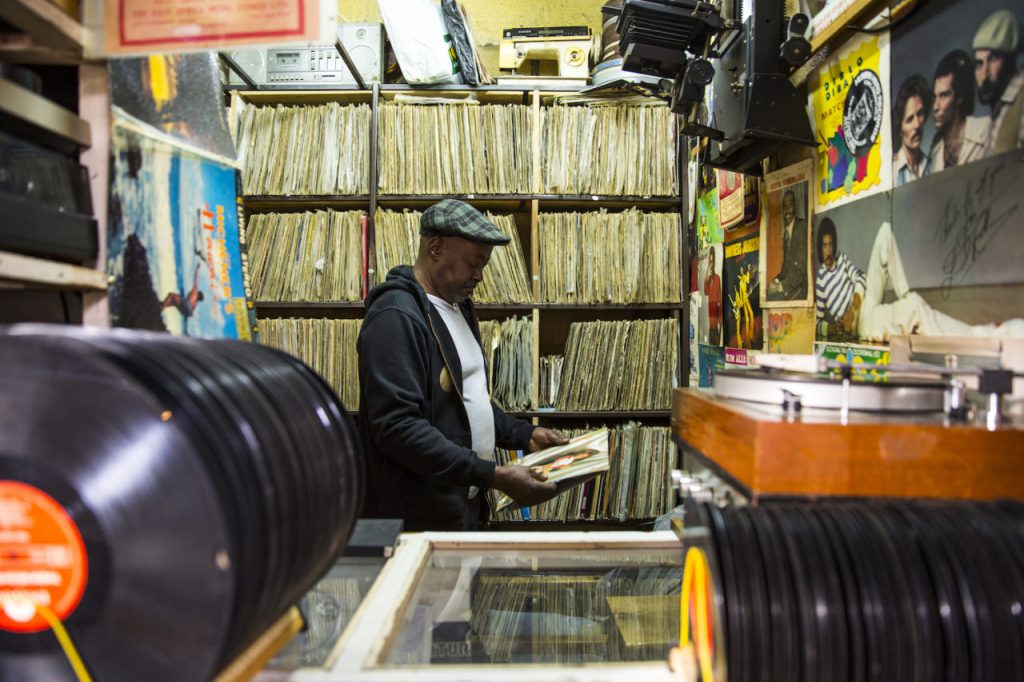
“My family didn’t have a musical background. I didn’t see a radio until high school, and we didn’t have a record player in our home until 1979,” recalls Jimmy with a nostalgic smile. In the 1980s, Jimmy made a living trading clothing in the town of Meru, nestled at the lush foothills of Mount Kenya. It was during this time that a broken record player, gifted by his brother, sparked his entrepreneurial spirit and yearning for something more exciting. “Once I fixed the machine, I drove to Nairobi and used all my savings to buy records. That was in 1986.”
“The music scene used to be vibrant. I was often invited to DJ at disco nights in local clubs and even at the army barracks. My sets mainly featured African music, including local records in languages like Kikuyu and Kamba, as well as some from Zaire, now the Democratic Republic of Congo,” reminisces Jimmy.
However, the erratic DJ lifestyle took its toll on Jimmy. “I loved the fast-paced life, with all the parties and the attention from ladies,” he confesses, a mischievous grin emerging. Seeking stability, Jimmy moved with his family to Nairobi in 1989. That’s when the legendary Kenyatta Market stall, now known far and wide, began selling music. Nestled amidst the bustling butcheries offering beef, goat, and chicken meat, the stall has remained relatively unchanged over the years. While it has expanded to include the adjacent stall, offering a wider variety of genres and attracting a broader customer base, the essence and charm of the place have endured.
“The location is pretty cool. I’m glad he decided to stay within the authentic ambiance of Kenyatta Market,” remarks Thomas Gesthuzien, a collector who has spent countless blissful hours digging through the store’s offerings.
The shop has weathered the decline of vinyl, the rise of tapes, the advent of CDs, and the threat of piracy by adapting to changing trends. In its early years, the shop primarily sold tapes, which Jimmy sourced from various locations across East Africa. “I used to drive all the way to Dar es Salaam, then take a boat to Zanzibar to buy tapes. That’s where I found the best stuff, especially jazz, which was either unavailable or very expensive in Nairobi.” However, despite sluggish sales, Jimmy’s intuition told him to acquire vinyl whenever he came across it. Soon, he had amassed a substantial collection of foreign and African records. He could go for months without selling a single one, but his passion for collecting vinyl couldn’t be extinguished.
“I began noticing a change about 10 or 12 years ago. People started coming into the shop and showing more interest in the few records I had. So I started bringing in more, and slowly but surely, they started selling.” Today, the shop predominantly sells vinyl, mostly featuring old Western music, alongside a vast collection of East African 7″ and some 12″ singles. One side of the stall houses the albums, while the other is filled with a vast selection of singles. In one corner, tucked away on the bottom shelves, lie Kenyan records divided by local languages: Swahili, Kikuyu, Kamba, Luo, and Luhya. Adjacent to them is an equally extensive collection of Lingala music, hailing from the Democratic Republic of Congo.
“He’s the only one catering to a growing crowd of vinyl lovers in Nairobi, especially among Kenyans, not just expatriates, and he does so with a genuine passion for the music,” says Thomas, who stumbled upon Jimmy’s place online five years ago. Thomas, also known as Gioumanne/J4/Jumanne, is a DJ and collector involved in research and licensing for reissue labels such as Strut, Soundway, Afro7, and Rush Hour. Since 1997, he has been running African Hip Hop, a website aimed at uniting individuals inspired by hip hop and the cultures of Africa and African origins. Recently, he has been working on the Kenya Special Second compilation by Soundway Records.
“I found one of the first records for the compilation at Jimmy’s. It’s an Afro rock single by a band called Awengele. When I played it on the turntable, he jokingly said, ‘If I had known about this, I would have kept it for myself,’ and then sold it to me at a very favorable price,” recalls Thomas.
While most foreigners visit Jimmy’s stall in search of African music, Kenyans exhibit an eclectic taste, equally drawn to local and international music. “At home, we listen to everything from African to international rock, blues, soul, pop, instrumental, classical, and reggae,” says Angela, one of Jimmy’s regular customers. Angela used to buy records online until she discovered Jimmy’s stall. She explains, “The real joy of going to Kenyatta Market stall is spending hours digging around and searching for that one treasure.”
Local interest in East African music is on the rise, as evidenced by the popularity of initiatives like Santuri Safari. Santuri, meaning ‘vinyl’ in Swahili, is a loose network comprising DJs, producers, musicians, and cultural activists aiming to bridge the gap between traditional artists, instruments, rhythms, and cultures and the cutting edge of the global underground music scene. Esa Williams, a UK-based South African DJ known for his involvement in the acclaimed Highlife World Series, is part of the Santuri network. In 2015, he visited Jimmy’s stall with David Tinning, a British DJ and avid vinyl enthusiast. Esa shares, “I was more interested in the story behind Jimmy, his record collection, and how he ended up in a meat market. We spoke for hours about the shop’s history, his regular customers, and his collection. Then I had time to dig and ended up getting a few records from his collection, including Letta Mbulu and Tabu Ley Rochereau.”

David Tinning, with an all-encompassing passion for vinyl spanning Jamaican dub, Afro-funk, disco, and techno, discovered ’80s boogie and disco records to enrich his collection. “Many of them had the names of their previous owners—often bands or DJs who were active in Nairobi in the ’80s or ’90s— which I find fascinating.” Gregg Tendwa, a Kenyan Santuri co-founder, stumbled upon a few Benga tunes for his archives. This discovery was particularly useful as Gregg is the mastermind behind Bengatronics, a sound blending cutting-edge electronics, irresistible Benga rhythms, and sugarcane-sweet guitar riffs.
Thomas affirms that young Nairobians are increasingly embracing East African music, thanks in part to the availability of classic and forgotten recordings at Jimmy’s stall. He shares his experience of playing 100% local music sourced from Jimmy’s collection at a monthly event called We Love Vinyl. Initially met with strange looks, the crowd ultimately loved it. This renewed access to classics and forgotten recordings has played a significant role in reconnecting young people with their musical heritage.
However, acquiring quality vinyl has become increasingly challenging for Jimmy as the popularity of African music grows among Kenyans and foreigners alike. “Sadly, as you can see, this is the only African 12″ we have,” Jimmy laments, pointing at a shelf with a small pile of boxes. “There is no more production around here, and they are becoming harder and harder to find.” Occasionally, people bring their LPs to Jimmy, asking him to digitize them. In other cases, he has to act like a predator, relying on his network of contacts in different regions of Kenya and Kampala, Uganda, who inform him when they come across individuals with a large stock of records. If the owners are unwilling to part with their collection, Jimmy gives their families his contact information and waits. During one visit to the stall, Jimmy received a large hoard of LPs, mostly African and in excellent condition. They were given to him by the son of a recently deceased woman who had no interest in keeping them. Jimmy provided the son with some money and the music in digital format in exchange.
Despite the challenges of sourcing vinyl, Jimmy remains optimistic about the future of Stall 570. Esa concurs, noting that places like Jimmy’s will always endure as trends come and go. Though they may not be as popular as record stores in the West, they keep the vinyl spirit alive.
For Jimmy, the stall represents not just music but also identity and roots. He believes it would be a great loss for future generations to forget their musical history and is always eager to share his knowledge with younger customers. Occasionally, he welcomes school groups and educates them about East Africa’s musical traditions.
As the sole proprietor of the stall since its inception, Jimmy’s primary concern is finding someone to take over. He already works seven days a week and rarely takes a break, fearing he might miss the chance to help someone discover their new favorite record. “The challenge is finding someone who wants to do this out of passion, not for money,” Jimmy says. “For me, this has been a labor of love. I’ve put my children through school and university thanks to my record shop, but no one will ever get rich from it.” Fortunately, Jimmy’s nephew Patrick shares his uncle’s passion and is being groomed to take over the shop. Patrick has plans to expand, but he will never move the stall. Stall 570, where it all began, will forever remain its home.